Home services
Plumber Website Design
Plumber website design built around one moment: a homeowner with a leak searches, finds you and calls. A page for every job, service-area pages with real local detail, your license on show and the schema behind it, built to rank locally without depending on ads.
Why it matters
What makes a plumber's site get the call
Three things decide whether the phone rings from search instead of from ads:
What is included
What every plumber website I build includes
Standard in every project, one truck or a dozen. It is the same call-first approach I use for locksmith websites, tuned for plumbing.
One page per job
Emergency plumbing, drain cleaning, water heater repair, frozen and burst pipes, leak detection, sewer lines. Homeowners search for the problem, not your company name, so each job gets its own page with its own questions and next steps.
Service-area pages that say something
Not a list of towns with the same text swapped in. Each area page carries what is actually true there: how old the housing is, who runs the water and sewer pipes, who issues plumbing permits, and which of your services that area calls about.
Call-first, emergency-first
Someone with water on the floor does not fill in forms. A tap-to-call button on every page, a sticky call bar on phones, shut-off-valve steps where a panicked visitor will see them, and a number that matches your Business Profile exactly.
Your license on show
License type and number on the site, with a link to your state's public lookup so the homeowner can check it in ten seconds. Unlicensed operators and call centers cannot copy that, which makes it the cheapest trust signal you have.
Plumber schema done properly
Plumber, a LocalBusiness type, with your real service area, plus Service, FAQ and breadcrumb markup. Conservative and honest: no self-awarded review stars that Google ignores anyway.
Fast, static, measurable
Static pages on a global edge network, and a first-party counter for every tap on your phone number, by page and by placement, that needs no cookies and no consent banner.
Case study
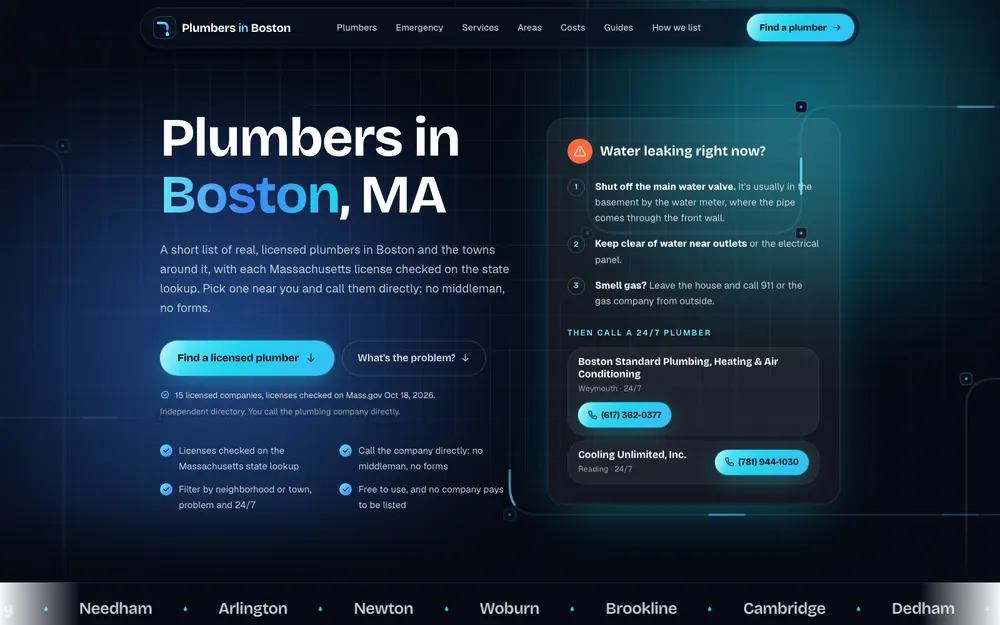
Plumbers in Boston, a licensed plumber directory I built and run
My own project: an independent directory of licensed plumbing companies in Boston and the towns around it. Building it meant doing everything a plumber's site needs, for fifteen companies at once.
The site has 6 job pages, 24 neighborhood and town pages and 3 guides, 41 pages in all. Every area page is written from official sources: the share of homes built before 1940 from the U.S. Census Bureau, who runs the water and sewer pipes, and who issues plumbing permits.
Before anyone is listed, their license is checked on the Massachusetts license lookup. Of the first 24 companies checked, 15 were listed and 5 failed: a suspended license, an expired company license, a journeyman license alone, and two with no plumbing license at all.
Under the hood: static Next.js on Cloudflare, a Plumber schema entity for every listed company, an emergency panel with shut-off steps above the fold, and an anonymous count of every tap on a phone number by company, page and placement, with no cookies.
Pricing
What decides the price of a plumber website
There is no fixed list price for a plumbing site. These are the items that move it.
Pricing factors
- Number of job pages, and whether heating, cooling and gas fitting are included
- Number of service-area pages and how much genuine local detail each gets
- One shop, or several branches with their own areas and numbers
- Migration from an existing site: redirect mapping and content audit
- Photography: real vans, crews and finished jobs versus stock imagery
- Call tracking, Google Ads landing pages and analytics setup
- Monthly SEO retainer after launch (content, reviews, reporting)
Clear quote
Thirty-minute brief, written quote
Tell me your towns, your jobs and what the current site does. You get a detailed quote the same day.
Process
From brief to launch in five steps
You know what is happening at each stage, how long it takes and what I need from you.
Research
Keyword clusters for your towns, a look at who actually holds page one, an audit of the current site and its backlinks, and a map of every old URL.
Architecture
Which pages exist and why: jobs, areas, emergency, pricing, guides. Every page has a search behind it or it does not get built.
Build
Next.js, static export, content checked against rules for title length, description length and minimum depth, so nothing thin ships.
Migration & launch
Redirects for every old URL, DNS moved without downtime, sitemap submitted, privacy and accessibility pages in place.
Measure
Search Console, a private call-tap dashboard, and a monthly report that says which pages make the phone ring.
Questions
Questions about plumber websites
Why does a plumber need more than a one-page site?
+
Should my license number be on my website?
+
Can a local plumber's site compete with the big lead-generation directories?
+
Do I need online booking or a contact form?
+
How is the website priced?
+
More finished sites are on the references page, and the general FAQ covers timelines, hosting and ownership.
Your towns, your jobs, a site that ranks for them.
One truck or several branches. Send the form and I will come back with questions and a quote.