TL;DR
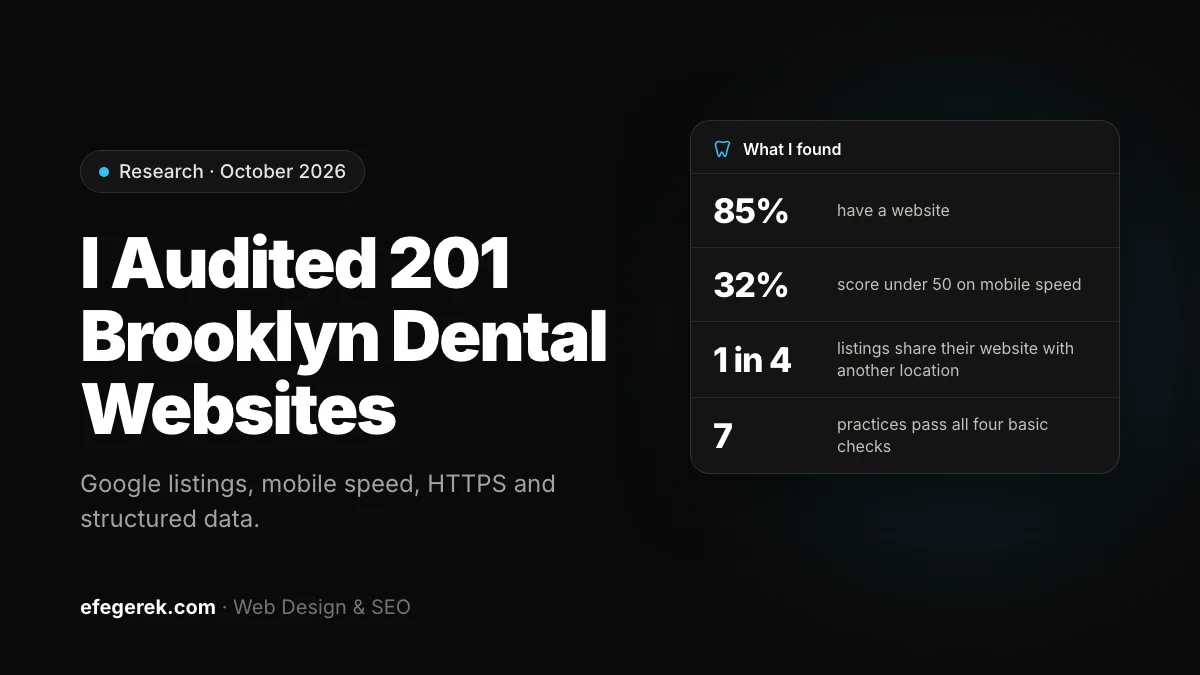
In October 2026 I audited 201 Brooklyn dental practices with a Google Business Profile. 85% have a website, so the gap is quality rather than presence: the median mobile speed score is 59 out of 100, a third of sites score under 50, and 37% carry no structured data at all. Only 7 practices pass all four basic checks: the site opens, HTTPS is valid, LocalBusiness schema is present and the mobile score is 90 or higher.
Most Brooklyn dental practices have a website; very few have a fast, well-built one. In October 2026 I audited 201 practices with a Google Business Profile in Brooklyn: 85% list a website, but the median mobile speed score is 59 out of 100 and only 7 practices pass all four basic checks.
I ran the same survey on 1,178 dental clinics in Istanbul in June (written up in Turkish), using a tool I built for surveying local markets. This post shares aggregate results only; no practice is named. The point is not to call anyone out but to show, with numbers, what a patient actually finds when they search for a dentist in Brooklyn.
The Short Version
- Websites are standard. 171 of 201 practices (85%) list a website. In Istanbul it was 77%.
- Speed is the weak spot. The median mobile score is 59; 32% of sites score under 50 and only 13 sites (8.6%) reach 90.
- Structured data is half done. 37% of sites have no structured data at all; 58% declare a LocalBusiness type.
- Reviews are an arms race. The median listing has 180 Google reviews, and 10 practices have more than 1,000.
- Groups share one site. 42 listings share their website with another listing, and most of them send patients to the same homepage.
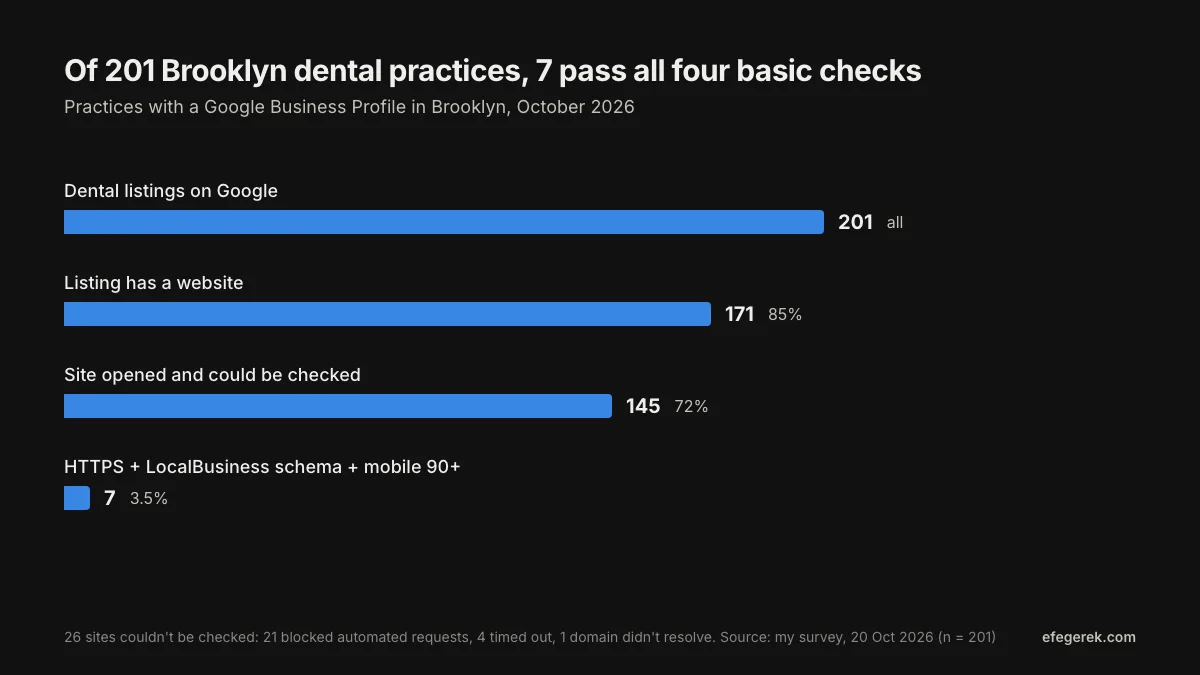
Finding 1: Almost Every Practice Has a Website
171 of the 201 practices list a website on their Google profile. The 30 without one are mostly small: a median of 14 reviews and an average rating of 3.76, against 4.46 for practices with a site.
Only 3 practices without a website have both a 4.5+ rating and 50+ reviews. In Istanbul I found 100 clinics like that. In Brooklyn, the opportunity is not getting online; it is being better online than the practice two blocks away.
The sites themselves mostly work. Only 5 of 171 (3%) failed to open: 4 timed out and 1 domain no longer resolved.
Another 21 sites blocked my automated check outright, which is common with bot protection; they probably load fine for patients, so I left them out of the numbers rather than counting them as failures. Of the sites that opened, 4 had no valid HTTPS certificate.
Finding 2: Speed Is Where Brooklyn Practices Lose Patients
I measured mobile performance with Google PageSpeed Insights on the 152 sites that returned a score. The median is 59 out of 100. Lighthouse treats 90 and above as good, 50 to 89 as needing improvement and under 50 as poor.
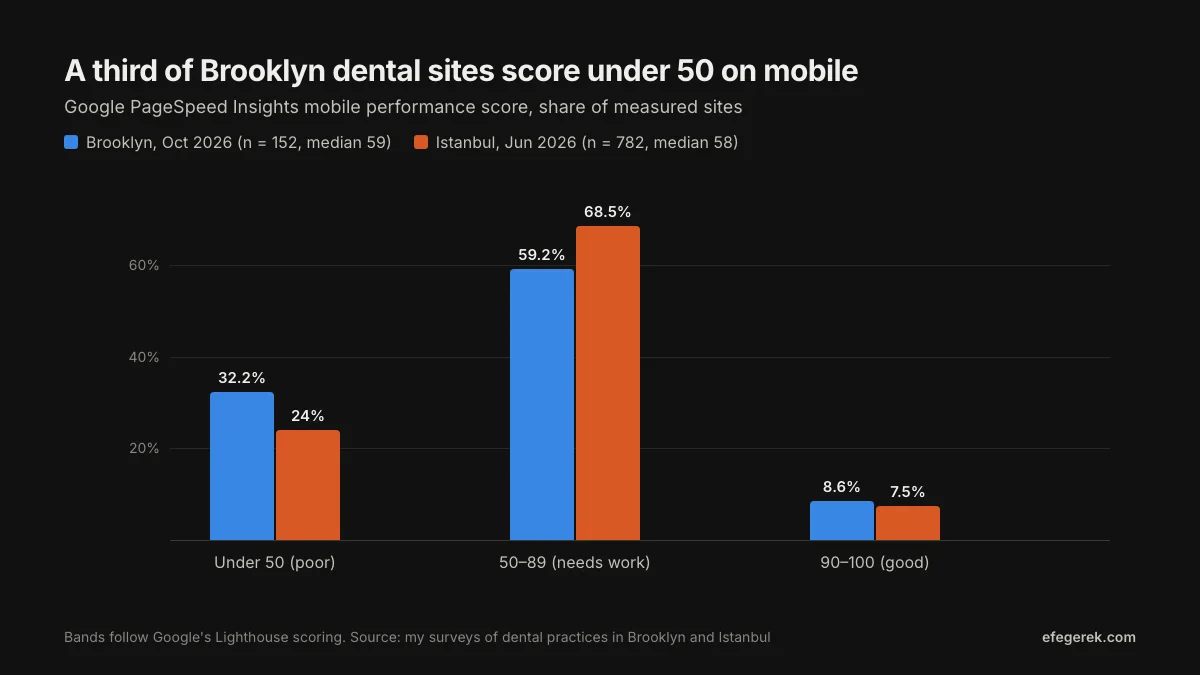
A third of Brooklyn sites (32%) score under 50, more than in Istanbul (24%). Only 13 sites reach 90. The medians are almost identical (59 and 58), but Brooklyn has a longer slow tail.
This matters because the typical dental search happens on a phone, often with some urgency. A page that takes several seconds to show anything sends the patient back to the results and on to the next practice. Google's page experience documentation also confirms that Core Web Vitals are used by its ranking systems, although relevance comes first.
Finding 3: Structured Data Is Half Done
Structured data (schema markup) is the code that tells search engines, in a format they don't have to guess, that a page belongs to a dental practice with a given address, phone number and opening hours.
Of the 145 sites whose HTML I could read, 37% have no structured data at all and 58% declare a LocalBusiness type. That is better than Istanbul (45% and 48%), but it still means more than a third of Brooklyn practices give search engines nothing to work with. schema.org even has a specific type for this: Dentist.
Put the four basics together (the site opens, HTTPS is valid, LocalBusiness schema is present and the mobile score is 90+) and only 7 practices pass. That is 3.5% of all listings, and 4% of the practices that have a website.
Finding 4: Reviews Are an Arms Race
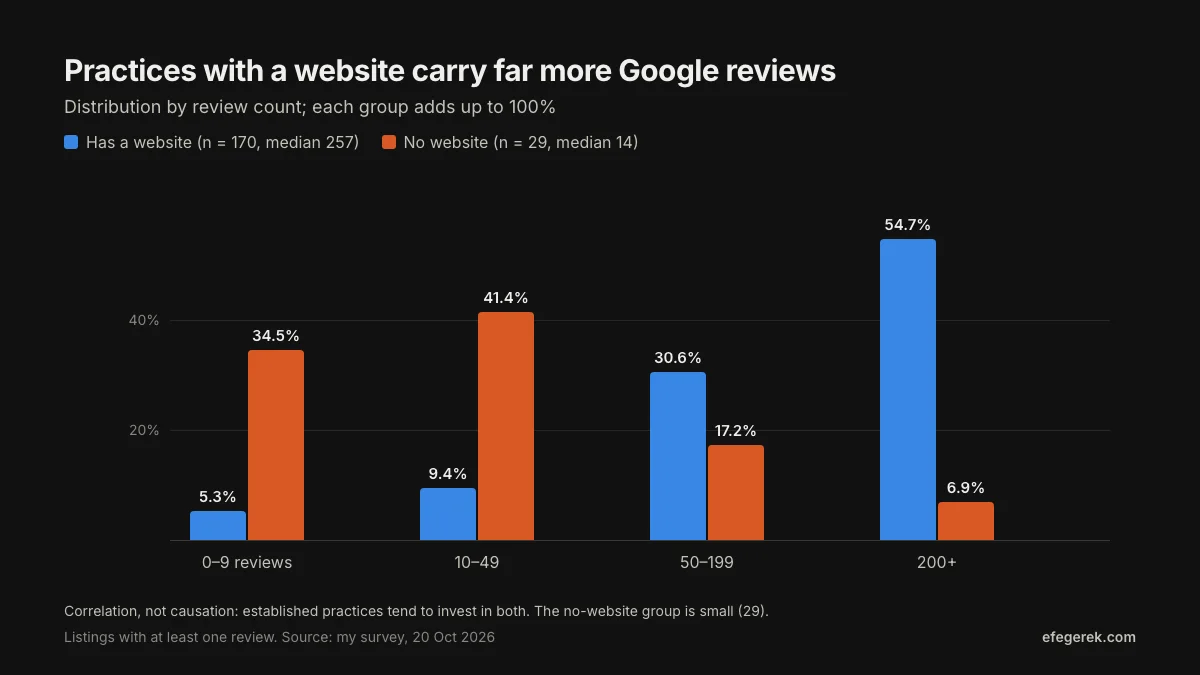
The median Brooklyn dental listing has 180 Google reviews. Practices with a website have a median of about 257; practices without one have 14. More than half of the practices with a website (55%) have over 200 reviews, and 10 practices have over 1,000.
Ratings are also more spread out than in my Istanbul surveys. 62% of Brooklyn practices are rated 4.5 or higher, only 12% have a perfect 5.0, and 22% sit below 4.0. In a market where most competitors have hundreds of reviews and ratings genuinely vary, a patient comparing three practices on the map has real information to go on.
This is a correlation, not proof that a website brings reviews: established, busy practices tend to invest in both. The no-website group is also small (29 practices with reviews), so read that side of the chart with care.
Finding 5: One Website, Many Listings
42 listings (a quarter of those with a website) share their website with at least one other listing, across 17 domains. These are group practices, multi-location brands and hospital dental services.
How they link matters. Of those 42 listings, 27 send patients to the same homepage, and only 7 link to a page for that specific location. The rest point to a treatment or "about" page.
Google's guidelines for representing your business ask that each location's profile link to that location's own page. If a group has an office in Bay Ridge, a patient who taps "Website" on that office's listing should land on the Bay Ridge page, with that office's address, hours, dentists and directions, not on a homepage they have to dig through.
How Brooklyn Compares With Istanbul
| Brooklyn (Oct 2026) | Istanbul (Jun 2026) | |
|---|---|---|
| Practices surveyed | 201 | 1,178 |
| No real website | 15% | 23% |
| Sites that didn't open | 3% | about 10% |
| Median mobile score | 59 | 58 |
| Mobile score under 50 | 32% | 24% |
| No structured data | 37% | 45% |
| LocalBusiness schema | 58% | 48% |
The two cities are at different stages. Istanbul still has many good clinics without a website at all; in Brooklyn nearly everyone is online, and the competition has moved to speed, structure and reviews. One caveat on the "didn't open" row: in Brooklyn I excluded the 21 sites that blocked automated requests, so the two figures are not measured in exactly the same way.
Method
For transparency, here is how the numbers were produced.
- Source: Listings came from the Google Places API, searching for "dental clinic" at points 8 km apart across a box covering Brooklyn, de-duplicated by place ID. Listings whose address was not in Brooklyn were left out. The survey ran on 20 October 2026.
- A sample, not a census: Each search returns at most 60 results, so a grid this wide mostly captures the more prominent practices. Brooklyn has far more than 201 dental offices. The list also includes 4 hospital or health-center dental services.
- "No real website": No website on the listing, or only a social media profile (none in this sample were social-only).
- Measurements: The mobile score is the Google PageSpeed Insights (Lighthouse) mobile performance score. HTTPS means a valid, trusted, unexpired TLS certificate. Schema means parseable JSON-LD on the homepage.
- Denominators: A site that couldn't be measured for a signal is left out of that signal rather than counted as a failure. That is why the sample sizes differ: 171 sites, 152 with a mobile score, 145 with readable HTML.
What This Means for a Brooklyn Dental Practice
If you run a practice in Brooklyn, four checks take less than an hour:
- Run your homepage through PageSpeed Insights on mobile. A score under 50 usually comes from a heavy theme, oversized images or slow hosting, and all three are fixable.
- Check your structured data. Paste your homepage into the Schema Markup Validator and look for a Dentist or LocalBusiness type with your address, phone number and hours.
- If you have several offices, give each one its own page, and link each Google listing to its own office page rather than the homepage.
- Keep reviews coming. Ask every satisfied patient, reply to every review, and never offer anything in return for one.
I build fast websites for dental clinics on Next.js and Cloudflare, with the structured data done properly; the dental clinic website page explains what is included. For a full build and what it delivered afterwards, see the Günaydın Dental Clinic case study, and for a US local search rebuild, the We Do Locksmith case study.
If you want to know where your own practice sits in this data, get in touch.