TL;DR
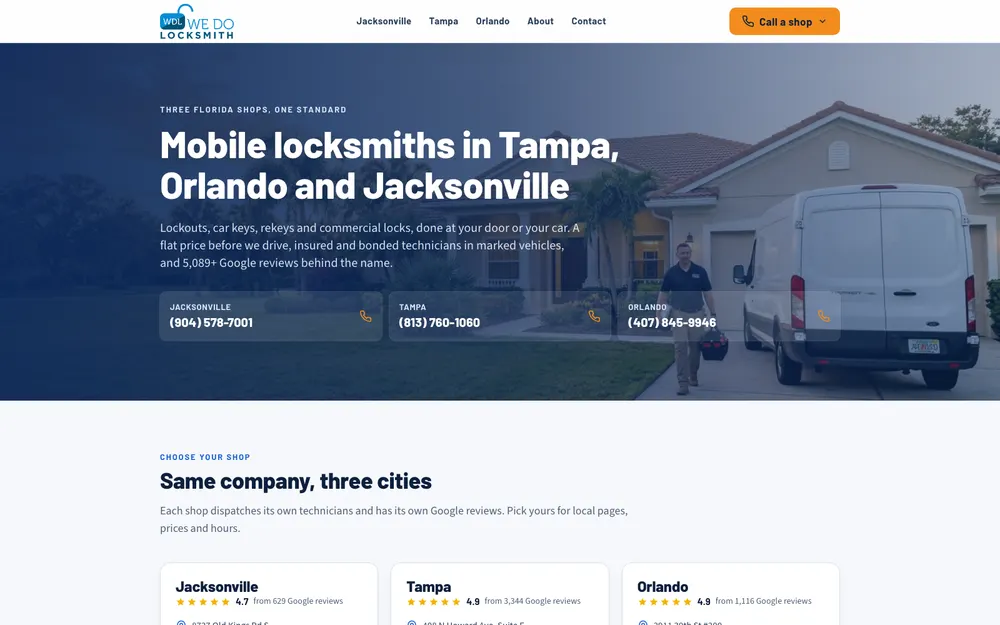
A three-shop Florida locksmith had an ageing WordPress site and an ads-only landing page for its Jacksonville shop. I rebuilt the whole domain: a brand homepage, a full Jacksonville section with service, car-make, area and guide pages, hub pages for Tampa and Orlando, every old URL redirected, and an anonymous first-party call-click log. Launch scores: Lighthouse 97 performance, 100 SEO, accessibility and best practices.
Locksmith searches are among the most urgent queries Google handles. Someone is standing next to a locked car at night, types a few words, and calls whoever looks real and close. The website's only job is to be that result and make the call easy. This is how I rebuilt one for We Do Locksmith, a locksmith with shops in Jacksonville, Tampa and Orlando, Florida.
The starting point
The brand's main domain ran on an ageing WordPress install that mostly talked about one city. The Jacksonville shop lived on a separate subdomain built purely as a Google Ads landing page, with no organic intent behind it. The result was a shop with a strong Google Business Profile and almost no organic presence in its own city.
The goal was narrow on purpose: give Jacksonville a site that can rank for its own service and neighbourhood searches, keep Tampa and Orlando fully functional, and do it without losing anything the old URLs still carried.
What was delivered
Everything lives on one domain now:
| Section | What it holds |
|---|---|
| Brand homepage | Three shops, one standard, a call button per city |
| Jacksonville | 13 service pages, 32 car-make pages, 23 service-area pages, pricing, military discount, reviews, three long-form guides |
| Tampa and Orlando | One complete hub page each, with room to grow |
| Company | About, contact, privacy policy, accessibility statement |
The Jacksonville section is deliberately deep. A car lockout, a lost key fob and an ignition repair are different searches with different prices and different questions, so each gets its own page. Car-make pages cover the searches directories never write for. Area pages carry real local notes and drive times rather than a city name pasted into a template.
Also included:
- A call-first site: a call button on every page, a sticky call bar on phones, and a number that matches the Business Profile exactly, with the ads team's attribution preserved for paid visitors
- Every old URL from the domain and the subdomain redirected, and DNS moved with no downtime
- An anonymous, cookie-free count of every tap on a phone link, shown to the owner on a private dashboard by day, page and source, so he can see which pages make the phone ring
- Structured data for each shop, and privacy and accessibility pages that keep the business out of trouble
Launch numbers
- Lighthouse: 97 performance, 100 SEO, 100 accessibility, 100 best practices
- 84 indexable pages, every one with a unique title and description within range
- Zero broken internal links, zero issues in two independent site crawls
- Sub-second loads worldwide, images served in modern formats
Rankings are tracked monthly from a baseline of no top-ten positions for the tracked Jacksonville queries. That is the honest starting line, and the reason the project exists.
What carries over
The pattern is not specific to locksmiths. Any local service business with many distinct jobs, a real service area and phone-first customers benefits from the same approach. If that sounds like your business, the locksmith website page explains what is included and how pricing works.